
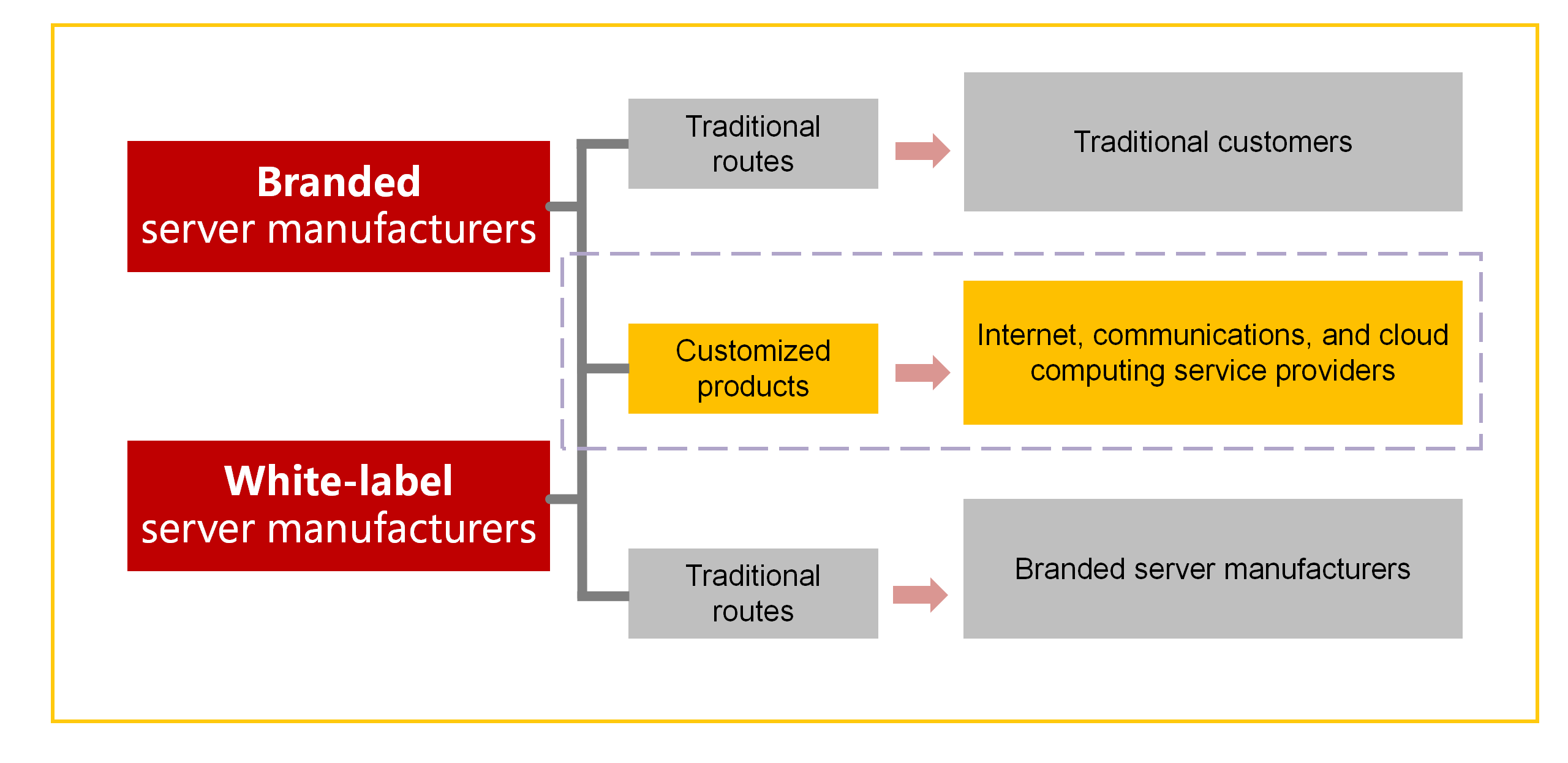
Cloud computing is expected to drive a new round of server growth, and in this wave of growth, we see that white-label server manufacturers have also maintained rapid growth.
A natural question is: Will white-label server manufacturers replace branded server manufacturers? In this report, we conducted an in-depth comparison and analysis of the above two types of server manufacturers, mainly answering the following four questions:
(1)Why should you pay attention to white label machines?
(2)What is the reason for the rapid growth of white-label machines?
(3)Where is the boundary between white-label servers and branded servers?
(4) From the perspective of future industry trends, there are development opportunities for white-label and branded products.
In this article, we will focus on the relationship between white-label vendors and branded vendors in the server field.
1. Why should we pay attention to white-label machines?
1. White-label server manufacturers.
White-label servers belong to a special group in the server competition landscape. We usually understand "white-label" as "no core technology, pure manufacturing, low industry status, low added value" and so on.
A typical example is the OEM/ODM factories we saw in the PC era, such as Foxconn, Quanta, Compal, Wistron, etc.
In the server field, there are also a group of such foundries that provide OEM/ODM services to brand manufacturers or server demanders.
2. Phenomena that require attention.
Although white-box servers do not receive much market attention, if we look at the global server revenue growth data in recent quarters, white-box server manufacturers are a group that is very worthy of analysis and research.
(1) Demand background: The driving factors behind the growth of server demand have changed.
In fact, white-label servers have a long history. As the saying goes, demand creates supply. The reason why white-label servers have a market is that downstream demand for white-label servers has emerged.
Traditionally, large enterprises purchase standardized servers provided by branded server manufacturers (IBM, HP, DELL, Inspur, Lenovo, etc.) (as opposed to the customized servers required by Internet companies).
The rise of cloud computing has created a large number of new demands for servers, making cloud computing vendors (Internet companies) the main driving force behind global server growth in the past four quarters.
Compared with the standardized servers required by traditional industries, cloud computing vendors need more servers that meet their own business needs, which are more customized and easier to deliver.
(2) Technical background: Open computing projects led by Internet giants.
The technical background of the rapid development of white-label servers is directly related to the demand background. Here we have to talk about the OCP Alliance (Open Compute Project) led by Facebook.
In 2012, Facebook launched the OCP project, which aims to change traditional servers, break down traditional computing components, and reconstruct them into modular systems.
Such a modular architecture can not only better meet the business needs of Internet companies such as Facebook, but also, by separating racks and server components, components can be developed independently, shortening the hardware development, upgrade, and innovation cycle.
It can be said that this is a way to speed up hardware upgrades. In the following years, the OCP Alliance continued to welcome Internet and cloud computing manufacturers such as Microsoft and Google to join.
In the above two industrial backgrounds, the demand for white-label servers came into being. It can be said that with the birth of Internet/cloud computing companies and the rapid development of their businesses, the demand for white-label servers has also emerged.
3. The reason why we pay attention to white-label servers at this time is mainly based on thinking about several issues.
First, why is the revenue growth rate of white-label servers showing signs of improvement at this point in time?
Second, judging from the industry evolution trend, can the growth rate of white-label servers be sustained? This requires us to analyze the changes and evolution path of downstream demand.
Third, the relationship between white-label and branded servers, including whether white-label servers will replace branded servers? From the perspective of the future evolution trend of server demand, which one will win out, white-label or branded?
2. What are the reasons for the rise of white-label machines?
Through the above content, we have a general understanding of the rapid growth of white-box servers in the past few quarters.
In this section, we will focus on analyzing the reasons behind the growth of white-label servers.
Reason 1: Industry background, cloud computing has become the main driving force for server growth.
According to Gartner data, global server sales in the first quarter of 2018 were US$15.25 billion, a year-on-year increase of US$4 billion, a year-on-year growth of 35.7%.
The main reason for its growth is that the global server market is driven by growth in spending by hyperscale data centers, large enterprises and medium-sized data centers.
In addition, in Q1 2018, cloud server sales reached $2.08 billion, up 126.5% year-on-year, contributing 51.7% to the overall market growth. In other words, for every $100 increase in global market capacity in this quarter, $51.7 came from cloud servers.
The global server growth rate has reached a turning point.
In fact, there is another set of data that deserves our special attention, which is the changes in the growth rate of global server revenue and shipments in the past few quarters.
The second reason is that cloud computing vendors’ demand for servers has changed.
The demand for servers in cloud computing is also changing. A major premise is that cloud service providers (mainly IaaS vendors) need to build large-scale cloud data centers to support the provision of cloud computing resources.
Therefore, server price, rapid deployment, and delivery efficiency are important considerations.
Different from the demand for standardized servers in general industries or general application scenarios, the Internet industry and cloud computing have their own particularities in terms of server requirements: including easy expansion, matching business attributes, and fast delivery.
Cloud computing has weakened the requirements for the performance indicators of a single server, and it requires more common two-way servers. This is also driven by the principle of parallel virtualization of multiple servers (machine clusters) in cloud computing.
Reason 3: Open source hardware brings development opportunities to white-label machines
The construction of cloud computing data centers has become the main driving force for global server growth in the past two years.
White-label servers are favored by cloud computing giants because of their low prices. Cloud computing vendors have solved the problem of customized standards for white-label servers by building the OCP Alliance and the ODCC Alliance.
Low prices and customized standards have made white-label servers one of the products that cloud computing vendors demand. It can be said that cloud computing has driven the continuous increase in the market share of white-label servers.
An important phenomenon we need to mention here is: hardware open source.
The corresponding concept, software open source, should be familiar to everyone. For example, many of the software we use, such as the Android operating system, virtualization technology, etc., their underlying codes are public (open source).
New software developers only need to develop new products based on these underlying codes. But what is the concept of hardware open source?
Hardware open source is similar to the logic of software open source. Software, circuit schematics, bills of materials, design drawings, etc. all use open source license agreements and are free to use and share, and are authorized for use in a completely open source manner.
In the server field, hardware open source comes from the two alliances we mentioned above: OCP (Open Compute Project) represented by Facebook and ODCC (Open Compute Center Committee) represented by BAT. The two alliances were established for the same purpose.
That is, by establishing server component standards, ODM factories can produce standard server components in large quantities, thereby reducing server production costs, while enabling rapid design and deployment of servers.
It is worth noting that behind the hardware open source led by Internet companies, there are also some connotations of hardware and software.
(1) The software upgrade and iteration cycle is faster than that of hardware. Internet companies’ businesses usually grow nonlinearly, which requires the speed of upgrading the basic hardware they use to increase accordingly. Therefore, the hardware update cycle can be shortened by separating components.
(2) The hardware modularization concept can improve the speed of hardware updates.
Internet giants have brought some influence on the industrial chain structure of servers by establishing open computing projects. That is, both OCP and domestic ODCC have tried to bypass server brand manufacturers to directly connect with ODM manufacturers, and hand over their own server design solutions and customization requirements to ODM foundries for production.
At present, this phenomenon is more obvious in the overseas server market.
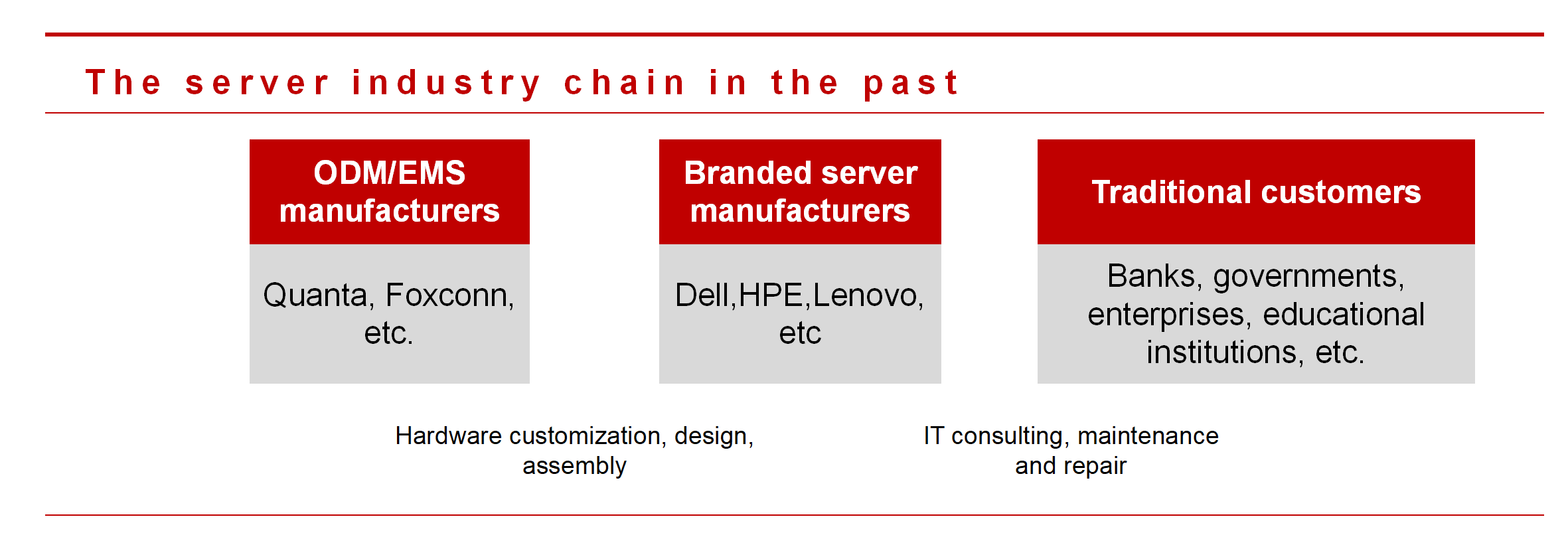
1) In the past business model, brand owners were a key link in the industrial chain.
The business model of the server industry has not changed much in the past. First, traditional brands such as HP, Lenovo, and Dell conduct research and development based on market trends, then commission ODMs to manufacture, and finally sell to end customers and provide corresponding after-sales services. Brands are the most critical link in the entire industry chain.
2) Current business model: The role of brands has been weakened.
Emerging industry in-depth research clients include Internet, communications, cloud computing service providers, etc. Since most cloud computing service providers have transformed from software companies and Internet companies, they are better than traditional server manufacturers in the development of management software, and do not need traditional server manufacturers to develop corresponding software, or the server underlying architecture and software parts that require brand server manufacturers to participate in the development and design have been reduced.
As mentioned above, the Cloud Computing Open Alliance has unified their customized solutions for server needs by establishing server standards.
Cloud computing manufacturers only need to hand over this customized solution to the foundry for direct procurement and production.
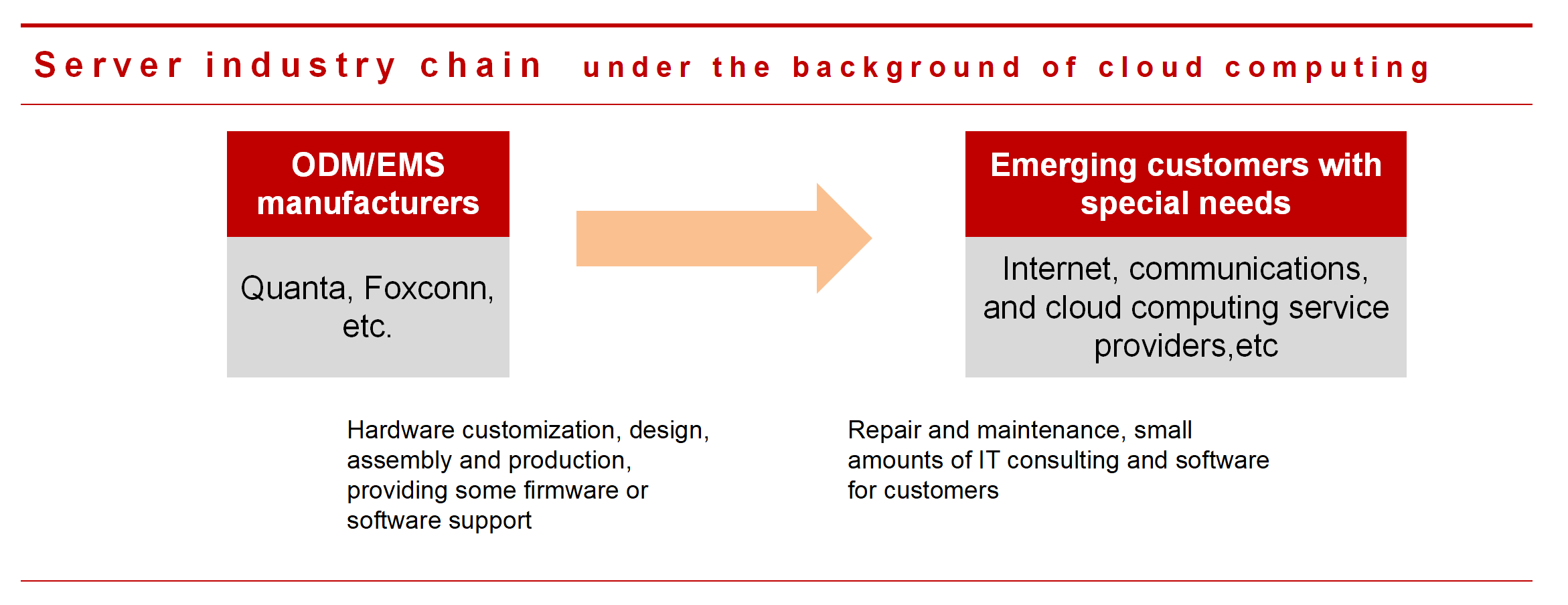
The transformation of IT technology has led to changes in the server industry chain. The role of brand owners in the industry chain has been relatively temporarily weakened, and ODM manufacturers have bypassed brand server manufacturers to work directly with customers.
In our previous report, "A Discussion on the Relationship between Servers and Cloud Computing," we proposed that every major technological change will herald the evolution of the industrial landscape, and even reconstruct the industrial chain, leading to a reshuffle of mainstream companies.
The same is true for cloud computing. The giants of the PC era and the giants of cloud computing centers have changed. The changes in the data center field brought by cloud computing are mainly reflected in two aspects: software definition and hardware reconstruction.
At the same time, cloud computing has brought certain changes to the competitive landscape of servers. Server manufacturers whose main customers are Internet cloud computing companies continue to benefit from the demand growth brought about by technological changes, and their market share continues to increase.
In recent years, cloud computing giants have continuously increased the construction of cloud data centers to support their huge cloud computing networks and rapidly growing Internet businesses.
It can be said that cloud computing (cloud data center construction) has become the main driving force behind the growth of global servers in the past two years. Therefore, it can be said that the driving factor behind the growth of white-label servers is cloud computing.
Let’s sort out the above logic again.
1) Changes in the industrial chain have led to the transfer of dominance from brand owners to cloud computing vendors.
The demand for servers in cloud computing is changing. Cloud service providers (mainly IaaS vendors) need to build large-scale cloud data centers to support the provision of cloud computing resources.
Therefore, the price, rapid deployment and delivery efficiency of the server are important factors to consider. Cloud computing vendors used to use branded general servers, but are now transitioning to using customized servers. In fact, this means that the dominance of server development and design has shifted from brand owners to cloud computing vendors.
2) White-label server manufacturers (OEMs) benefit from hardware open source.
The biggest advantage of white-label servers is that they are cheap and cost-effective. The reason why white-label server manufacturers can produce such products (which meet customer needs and are low-priced) is because the hardware is open source. It can be said that open source hardware has lowered the threshold for server manufacturing, but it should be noted that the threshold for server development and design is still relatively high.
3) Cost and rapid deployment are the main factors for cloud computing vendors to choose servers.
Cloud service providers (mainly IaaS vendors) need to build large-scale cloud data centers to support the provision of cloud computing resources. Therefore, server price, rapid deployment and delivery efficiency are important considerations.
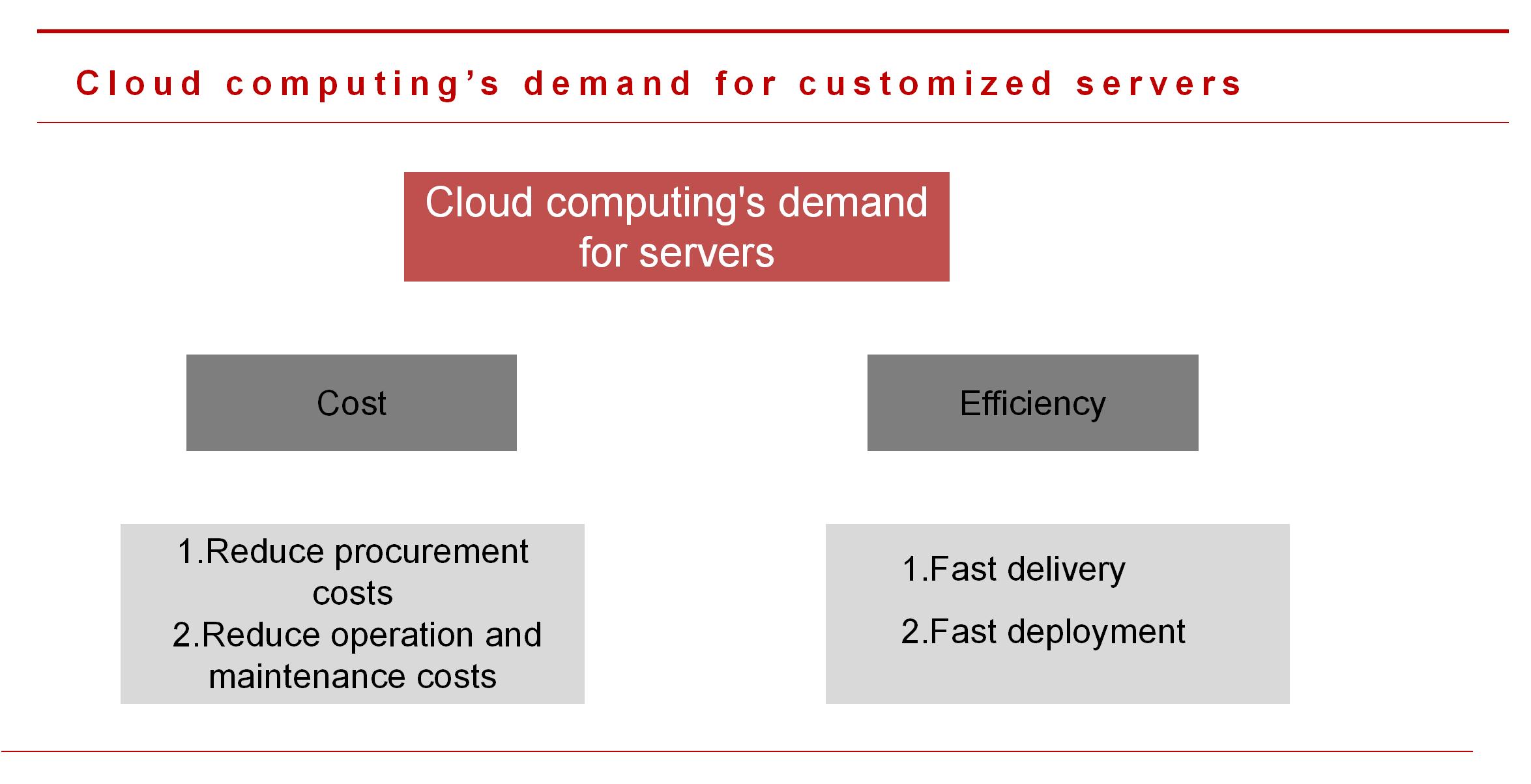
4) Cloud computing vendors have solved the problem of white-label server customization standards through OCP+ODCC.
White-label servers, which were previously unable to be deployed in data centers due to their lack of stability, are now favored by cloud computing giants because of their low prices.
In recent years, cloud computing vendors have standardized and strengthened the white-box server industry by establishing common hardware standards, namely the OCP Alliance and the ODCC Alliance.
It can be seen that when the strength of the demand side is strong enough (including a large amount of demand and strong enough technical strength), it can gradually dominate the entire industrial chain.
5) All changes come from cloud computing.
From the above we can see that whether it is the changes in the server industry chain, the changes in the competitive landscape of the server market, or the rise of white-label server manufacturers, all these changes are derived from cloud computing.
Cloud computing has restructured the entire industrial chain.
3. On the Boundary: White Label Branding, Brand White Labeling
White-label server manufacturers and branded server manufacturers were originally upstream and downstream players in the server industry chain. However, the development of technology and changes in demand have led to business overlap and competition between these two types of manufacturers with different industry divisions.
The business boundaries of enterprises are also changing with technological changes. This is a phenomenon we often see in the IT field.
We also found an interesting phenomenon between white-label and branded vendors: branded servers seem to be white-labeled, and white-label servers seem to be branded. The mutual integration between the two has caused the relationship between them to change constantly.
Before we analyze the phenomenon of "white-label branding, brand white-labeling" in detail, let's first analyze the business boundaries between brand servers and white-label servers. This will also allow us to further understand what factors lead to changes in the business boundaries of both parties?
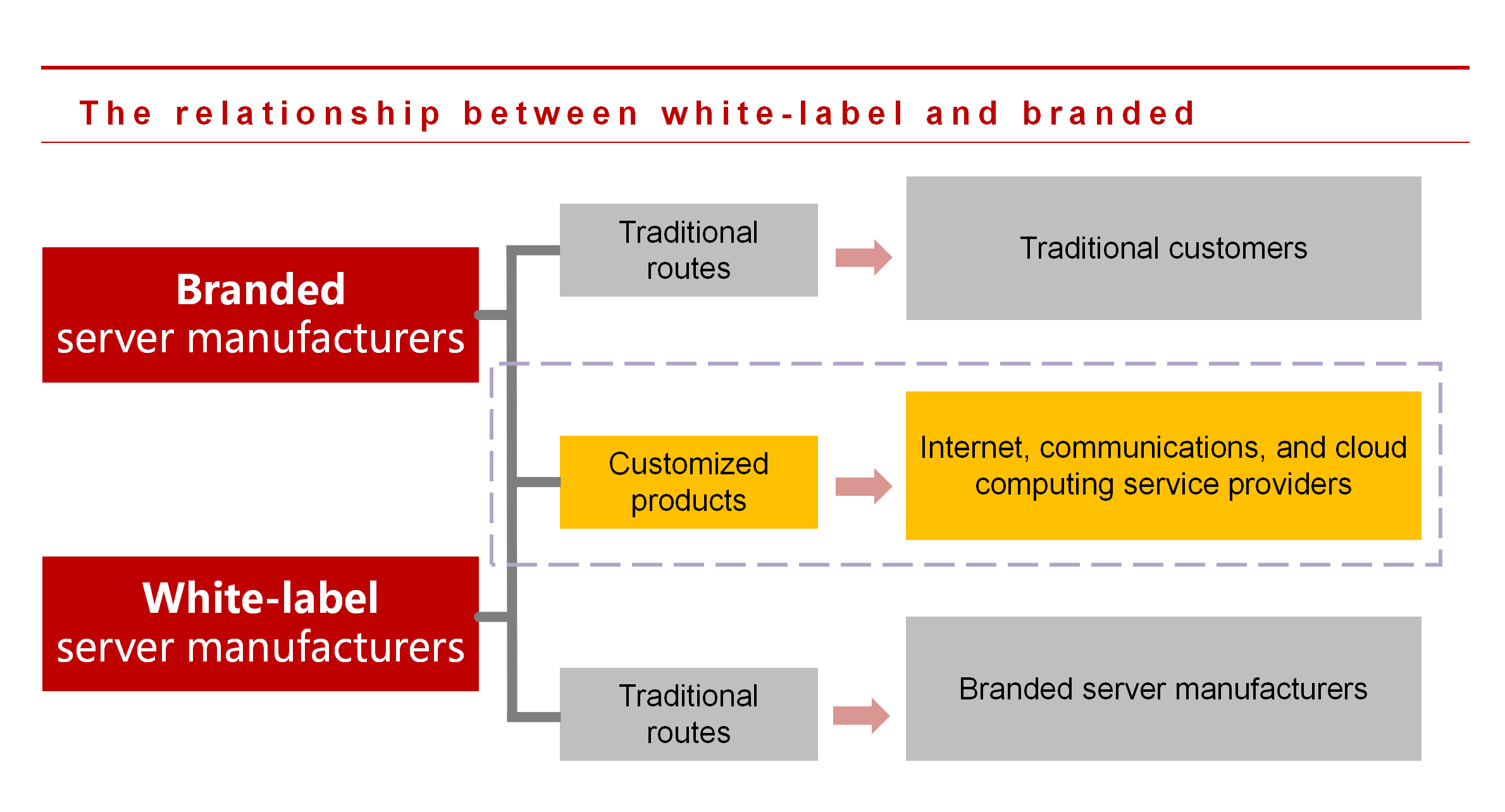
1. The boundaries of brand server manufacturers.
Under the original division of labor in the industrial chain, brand server manufacturers develop and design server architectures on their own, but the underlying software and hardware of the servers are obtained through outsourcing, including operating systems, databases, chips and some other raw materials.
For most brand servers, such as Dell, HP, Inspur, Lenovo, etc., the links they participate in the server industry chain include: server architecture design and development, management software development and deployment, and server production and manufacturing.
Some brand server manufacturers will outsource some low-end or all of their servers to OEM factories for assembly and production. This depends on whether the brand server manufacturer has a production line or enough production lines to support downstream demand.
The above links constitute the business boundaries of traditional brand server manufacturers, which can be summarized as development, design, and production of servers.
2. The boundaries of white-label server manufacturers.
For white-label server manufacturers, it is more related to the production and manufacturing of servers.
Generally speaking, white-label server manufacturers mainly leverage their large-scale production and manufacturing capabilities, cost control capabilities, and the ability to meet and implement customized needs.
Therefore, we can understand that under the traditional server industry chain architecture, the business boundary of the foundry (white-label server manufacturer) is: producing and manufacturing servers, and it does not have the ability to develop and design servers.
The open source of hardware has enabled some key links and parts in server development and design to be packaged and designed by cloud computing vendors, which has made it much easier for the original foundries to break through their own business boundaries.
3. The boundary between white-label and branded products.
Through the above analysis, we have a general understanding of the business relationship between brand manufacturers and white-label manufacturers (the original OEM factories).
In the context of the traditional server industry, brand server manufacturers have accumulated a large number of technical patents and architectural design experience for servers of different forms (including blades, towers, racks, etc.).
In addition, traditional server manufacturers also use their own software (non-open source) for server management software. This makes it possible to clearly distinguish between the original white-label and branded servers. These constitute white-label servers.
4. The boundaries between manufacturers and brand server manufacturers.
Next, we will discuss two very interesting phenomena in the server field: white-labeling and white-label branding. These two seemingly confusing expressions actually reflect a very important change in the server industry. And behind this change is more about the reconstruction of the industry by technology.
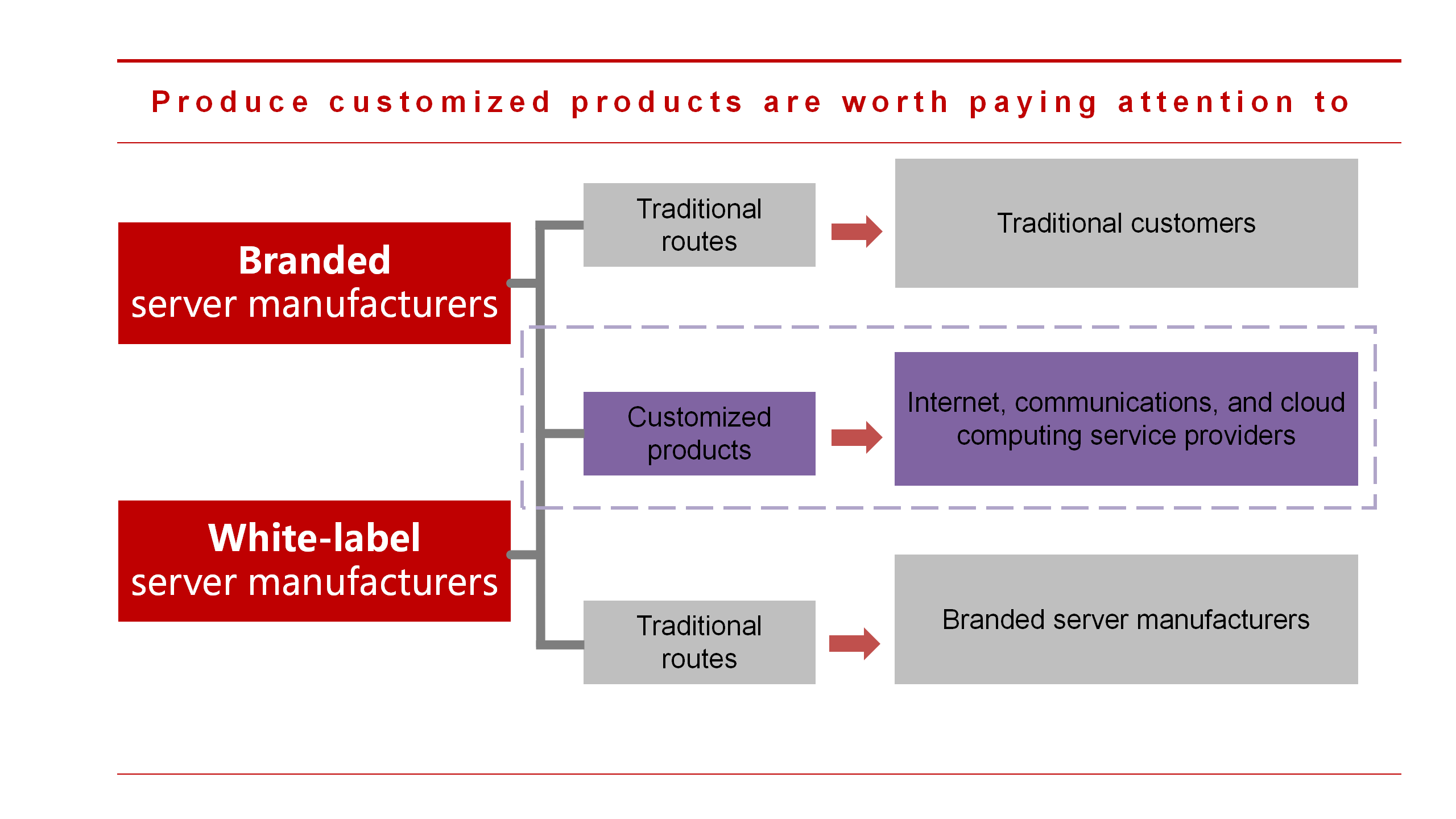
Brand white-labeling. On the surface, this sentence means that brand server manufacturers have begun to provide white-label servers. But we believe that the more important meaning is that brand server manufacturers have gradually begun to produce customized servers required by customers. It should be noted that:
(1) The premise for branded server manufacturers to produce customized servers is that the downstream demand is large enough. This demand is exactly what Internet companies and cloud computing companies generate.
(2) The emergence of customized servers actually reflects the evolution of the industrial chain structure, or the evolution of the dominance or discourse power of the industrial chain. It is precisely because the demand for servers from cloud computing vendors is large enough that the businesses of vendors in all links of the upstream industrial chain are all developed around this strong demand.
Of course, we also need to understand the background. Before the server growth driven by cloud computing, the global server revenue growth rate has remained in the single digits, and even declined year-on-year in some quarters.
(3) Branded server manufacturers produce customized servers, which is driven by both industry changes and self-driven choices of server manufacturers. In the face of competition from white-label servers in the cloud computing demand for servers, if branded server manufacturers do not produce customized servers, they may fall behind in the cloud computing wave.
Correspondingly, we have seen that server manufacturers whose main customers are Internet/cloud computing companies have taken the lead in developing and designing the infrastructure required by customers (Internet/cloud computing companies) or accepting customized solutions from customers.
These server manufacturers are also the biggest beneficiaries of this wave of server growth driven by cloud computing. Their revenue growth has maintained a relatively fast growth in recent quarters. In China, Inspur Information is the main player, while overseas, Dell is the main player.
5. White label branding.
Thanks to hardware open source technology and the experience of Internet giants in server design, the boundaries between white-label OEMs and brand manufacturers have been broken. White-label manufacturers' server products are also gradually becoming branded in disguise. For example, original OEMs such as Foxconn, Quanta, and Wistron are also gradually launching their own branded servers.
These companies launch their own brand servers mostly through subsidiaries. Quanta's subsidiary Yunda and Wistron's subsidiary Wiwynn are the main entities that manufacture servers for OEM factories.
4. Brand manufacturers’ counterattack
Faced with competition from white-label vendors, how will branded server vendors make decisions in the future? This inevitably leads to two questions:
(1) How will the relationship between white-label and branded manufacturers evolve?
(2) How do brand manufacturers fight back against competition from white-label manufacturers? Let’s analyze them one by one below.
1. How will the relationship between white-label and branded products evolve? White-label and branded products: competition or cooperation?
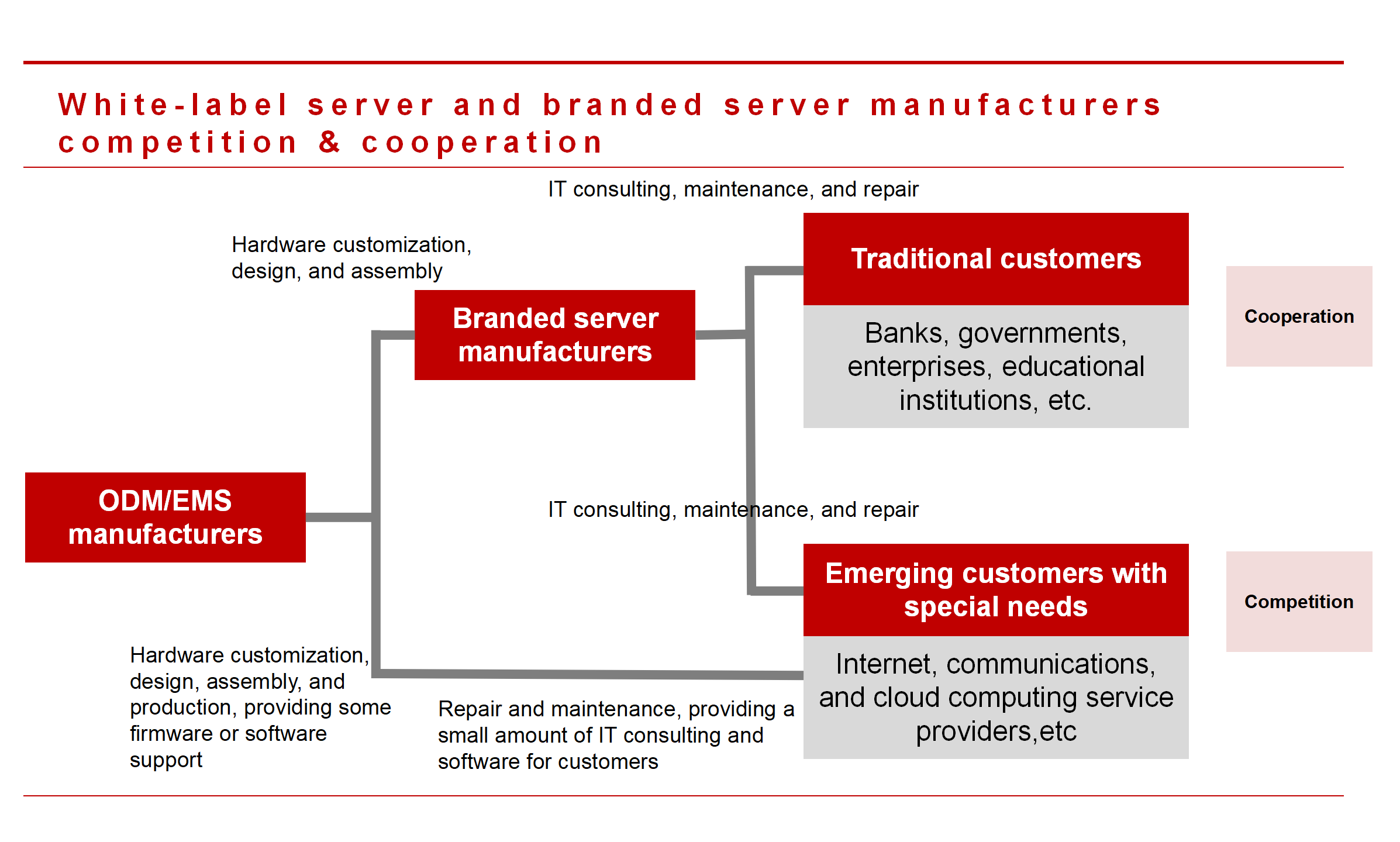
In the traditional server industry chain, white-label and branded vendors are in an upstream-downstream relationship, cooperating and interdependent with each other. In the cloud server industry chain, white-label and branded vendors have a certain degree of overlap in products and customers, but they are also in a competitive relationship.
We believe that this "cooperative and competitive" relationship between white-label and branded products will continue to exist. This is not determined by their respective industry positioning, but by downstream demand.
The two sides conduct industrial cooperation and competition based on their respective advantages in the industrial chain. In the field of traditional industry customers, white-label and branded products are still in an upstream and downstream relationship; in the field of Internet and cloud computing, white-label and branded products are more of a competitive relationship.
2. White label and brand: cooperation and integration.
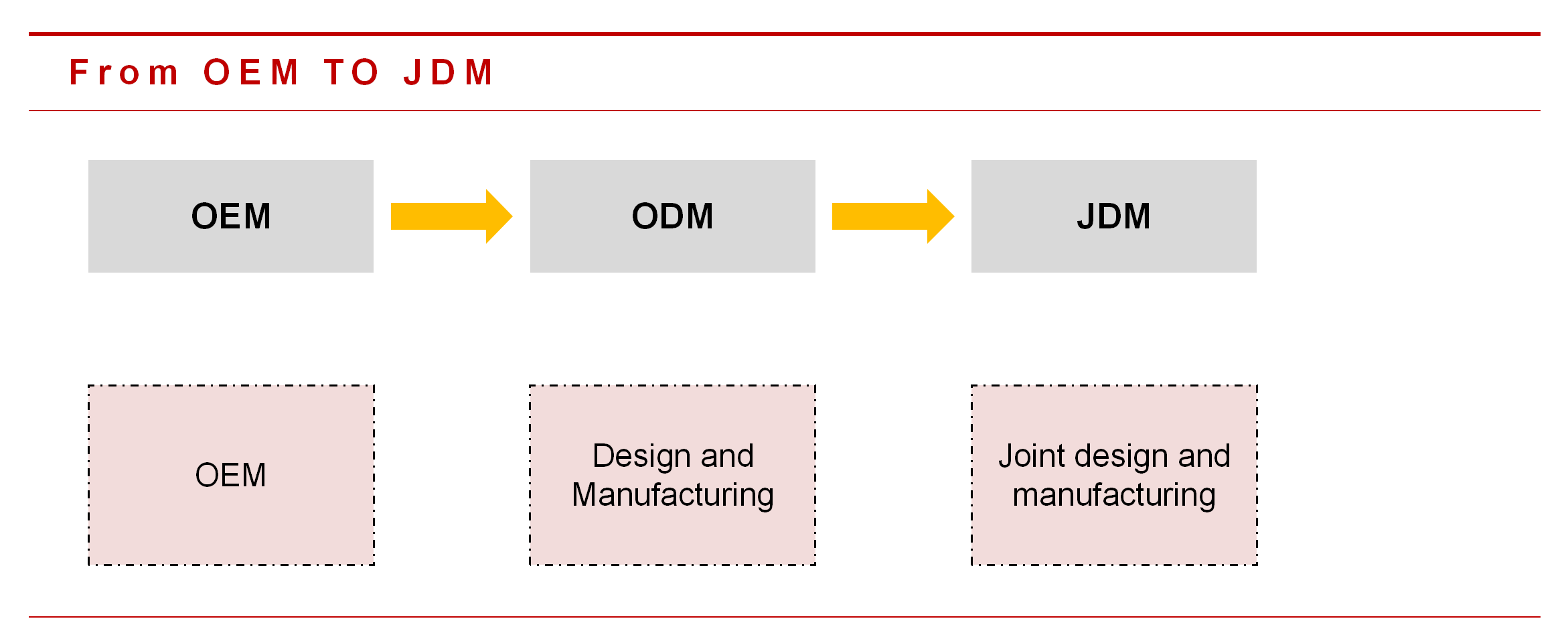
It is worth noting that even in the field of cloud servers where there is a certain overlap in business, white-label and branded products are gradually merging and collaborating, just like the cooperation between PC developers and designers and OEMs in the PC era.
3. The JDM model brings improved capabilities to server manufacturers.
For server manufacturers, the JDM model not only brings about rapid product development and delivery, but also has greater significance in improving the server manufacturers' R&D and productization capabilities.
The main logic is: server manufacturers study common scenarios through the JDM model and obtain standardized products, and then conduct secondary development and optimization based on the needs of industry users and apply them to traditional industries.
Based on the above, we can see that:
(1) The relationship between white-label server manufacturers and branded server manufacturers is not simply a substitute relationship; there is also an upstream and downstream relationship, and there is both competition and cooperation between the two.
(2) In response to emerging Internet and cloud computing companies, some brand server manufacturers have already adopted customized development strategies to seize the lost market.
(3) Branded server manufacturers such as Inspur have improved their R&D and product capabilities through the joint development (JDM) model, meeting the needs of Internet companies and achieving rapid growth in shipments.
(4) Regarding the competition between brands and white-label products, we should also see that both parties are currently facing a larger new market brought about by technological changes, and are far from entering the stage of stock competition. In fact, we can see this from the current growth rate of shipments of various server manufacturers.
Only server manufacturers that match and meet the needs of cloud computing vendors can expect to grow rapidly, regardless of whether the manufacturer is a white-label or branded manufacturer.
(5) In the traditional server market, branded manufacturers are still the main force, and white-label manufacturers are still difficult to shake.
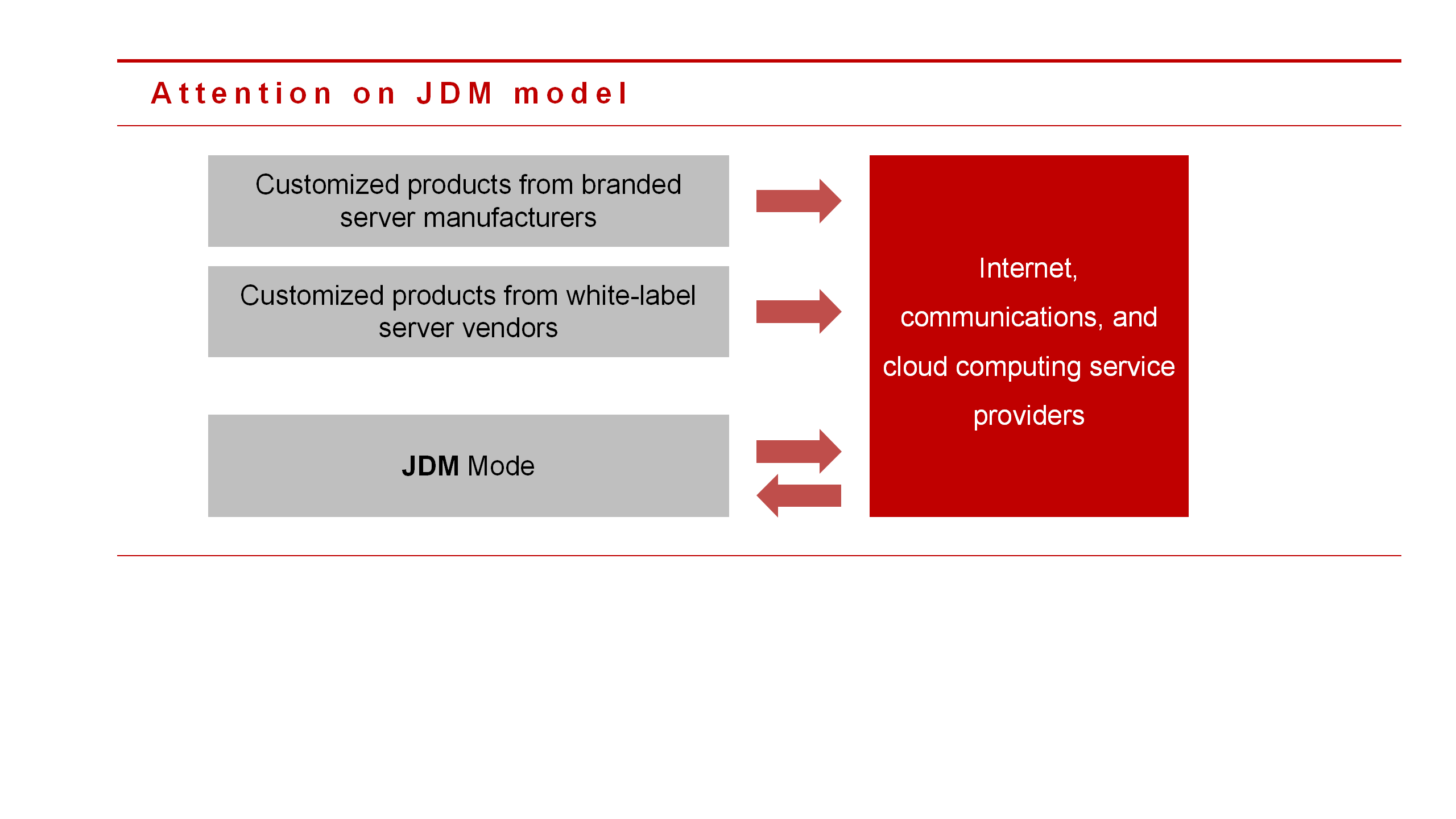
5. Comparison between white-label and branded products The strength comparison and core advantages between white-label and branded products determine the areas into which the two types of companies can ultimately expand their business boundaries.
Below we will make a corresponding comparison between white-label server manufacturers and branded server manufacturers in terms of technology, production capacity and cost control capabilities, stability and technical support service capabilities .
Comparison 1: Technical comparison.
(1) Branded server manufacturers have a large number of core patents and their own technical barriers. Blade, tower, and rack server products also reflect the changes in hardware architecture design by branded server manufacturers.
White-label server manufacturers lack technical accumulation and experience in product design and mainly rely on the technology output of the OCP Alliance.
(2) Traditional server management software mostly uses closed-source software developed by the brand itself. For server maintenance personnel, this software will greatly facilitate their work, which constitutes a natural moat for the brand and other products of the same generation of factories.
(3) Currently, most large cloud computing customers have the ability to develop management software and can handle and solve general problems. This has weakened the advantages of branded server manufacturers in software and maintenance. However, for general cloud computing customers and traditional industry customers, the technical advantages of branded manufacturers are still relatively obvious.
Therefore, based on the above analysis, branded server manufacturers have more advantages in terms of technical capabilities.
Comparison 2: Comparison of production capacity and cost control capabilities.
(1) White-label server manufacturers are transformed from OEM factories, so they have stronger cost control capabilities in the production process.
As for whether a company has bargaining power with upstream raw material manufacturers, whether it is involved in the development and design of servers, and whether the scale of production and manufacturing is large enough, these factors may have some impact.
Even so, server manufacturers have relatively limited bargaining power over core raw materials (such as chips, databases, operating systems, etc.). In particular, if the entire raw material procurement is uniformly formulated by cloud computing vendors, server manufacturers will have even weaker control over raw material prices.
(2) For brand server manufacturers that have already received a large number of orders from Internet enterprise customers and have the ability to mass-produce, their economies of scale are expected to gradually emerge. Production capacity and cost control capabilities are the new barriers built by these brand server manufacturers. Not all brand manufacturers have this capability.
Based on the above, white-label server manufacturers have more advantages in production capacity and cost control, but when the annual output of branded server manufacturers reaches hundreds of thousands or even millions of units, the scale effect will gradually emerge. The difference in cost control between white-label and branded manufacturers is almost negligible.
Comparison 3: Performance and stability.
(1) Each brand server is the result of decades of research and development and testing by the brand server manufacturer. Each accessory, wiring, and combination has undergone a large number of tests and experiments. Therefore, the server performance is very stable, and the server rarely crashes or freezes. Moreover, at the same price, the performance and stability of brand servers are more superior.
(2) Cloud computing service providers deploy multiple servers in parallel in a distributed architecture, so even if a single server crashes, it will not affect the overall service operation. Cloud computing vendors have lower requirements for server stability than traditional industries. Therefore, from this perspective, the difference between white-label and branded products is not that big.
Comparison 4: Comparison of technical support services.
Taking after-sales service as an example, cloud computing giants, due to their own capabilities and architectural characteristics, can handle most of the problems themselves as long as there are no major problems with the quality of the product itself. However, this does not apply to all large customers. The after-sales channels of white-label server manufacturers are relatively insufficient, and branded server manufacturers have more advantages.
6. ▌Will the future belong to white-label or branded products?
Which one can better grasp the future industry trend, white-label servers or branded servers? Here we divide the discussion into two levels.
First, in view of the current cloud computing industry trends, which manufacturers can win?
Second, what kind of products are needed for the future direction of industrial transformation?
1. Competition under the trend of cloud computing industry
After the above analysis, we can see that the main driving force for the growth of servers currently comes from cloud computing. At present, we have seen that technological changes have had a certain impact on the server industry landscape. We need to analyze the comparison between the two groups of competitors.
First, competition among brand server manufacturers.
In the wave of cloud computing industry, only brand server manufacturers that adapt to changes in industry trends and customer needs can continue to maintain rapid growth. At this stage, it is a customized strategy that integrates the needs of Internet/cloud computing manufacturers.
Second, the competition between customized brand manufacturers and white-label manufacturers.
Through the comparison of multiple dimensions above, we have seen that in the industrial stage where cloud computing drives the growth of servers, the gap between brand manufacturers and white-label manufacturers in certain aspects has been filled by the technology output of the Internet.
The JDM model of brand manufacturers may be more conducive to brand manufacturers' competition against white-label products. Of course, the above white-label products have their main application areas, namely the Internet/cloud computing field.
2. Competition in future industry trends
Trend 1: Heterogeneous computing era
First of all, we need to understand that the essence of the demand for servers is the demand for data computing resources. As long as there is a demand for data computing, there will be a continuous demand for servers.
Before artificial intelligence, the computing we generally needed was homogeneous computing, that is, inside the server, usually a CPU chip was running. In the era of artificial intelligence, heterogeneous computing may become a rigid demand.
Servers based on heterogeneous chips (including CPU, GPU, FPGA, and ASIC) are expected to become a new demand for Internet companies.
If in the cloud computing era, Internet companies need more standardized servers based on their own customized needs (leading to the rise of white-label server manufacturers), then in the AI era, the demand for heterogeneous computing servers is a more customized server, which requires server manufacturers to have core capabilities in software development and technological innovation, and the importance of software has increased. We believe that this is precisely an opportunity for branded server manufacturers.
Trend 2: Software-defined Era
As hardware computing power has gradually improved to a certain extent, software-defined hardware architecture has gradually expanded its application scope. In large cloud data centers, there are more and more servers optimized for specific applications.
Through software definition, the computing power of hardware can be maximized, or by refactoring the hardware, the computing power can be further improved and the scope of application can be expanded.
The hardware architecture of servers is already relatively mature and is expected to gradually enter the software-defined era. From this perspective, branded server manufacturers have more technical advantages in server software development.
It is worth noting that white-label server vendors like Wiwynn are also gradually accumulating server management software development capabilities.
In fact, even for branded server manufacturers, the software development capabilities of different companies are different. It should be noted that for mature hardware products, including servers, software development and design capabilities are one of the core factors that determine the future competitiveness of products.
In summary, facing the future stage of heterogeneous computing dominated by artificial intelligence and software-defined computing, software development capabilities have become one of the core elements of hardware server manufacturers.
This is generally the advantage of traditional brand manufacturers. On the other hand, we also see that some traditional white-label server manufacturers such as Wiwynn and Yunda are also accumulating their own software development capabilities.
Therefore, we believe that, whether for white-label or branded products, whether for current cloud computing or future AI-driven heterogeneous computing, only server manufacturers that continuously adapt to and match downstream customer needs and constantly adjust their own strategies and positioning can hope to continue to gain sustainable development capabilities.
Wuhan XINQIDIAN Technology Group Co., LTD
Address: No.36-1, Jindi Weixin JiangXia Zhi Zao Park, No. 6 Hejiahu Street, Bridge Modern Industrial Park, Jiangxia Economic Development Zone, Wuhan City, Hubei Province
Tel :027-50186797